The Orchid Delirium Mood Board
Welcome to 1967.
The Beatles are everywhere. Color film is overtaking black-and-white in movie theaters. Women, particularly women in academia, are still constrained by rigid expectations, yet pushing, persistently, against the limits placed on them. Rachel Carson and Marjory Stoneman Douglas are naming an environmental reckoning most would rather ignore, warning that the land remembers every wound.
Meanwhile, Black neighborhoods are quietly, efficiently erased, bulldozed to make room for highways and sold as progress. The understanding of mental illness is shifting as well; the long-standing faith in institutional confinement begins to falter, replaced by uneasy questions about care, autonomy, and control.
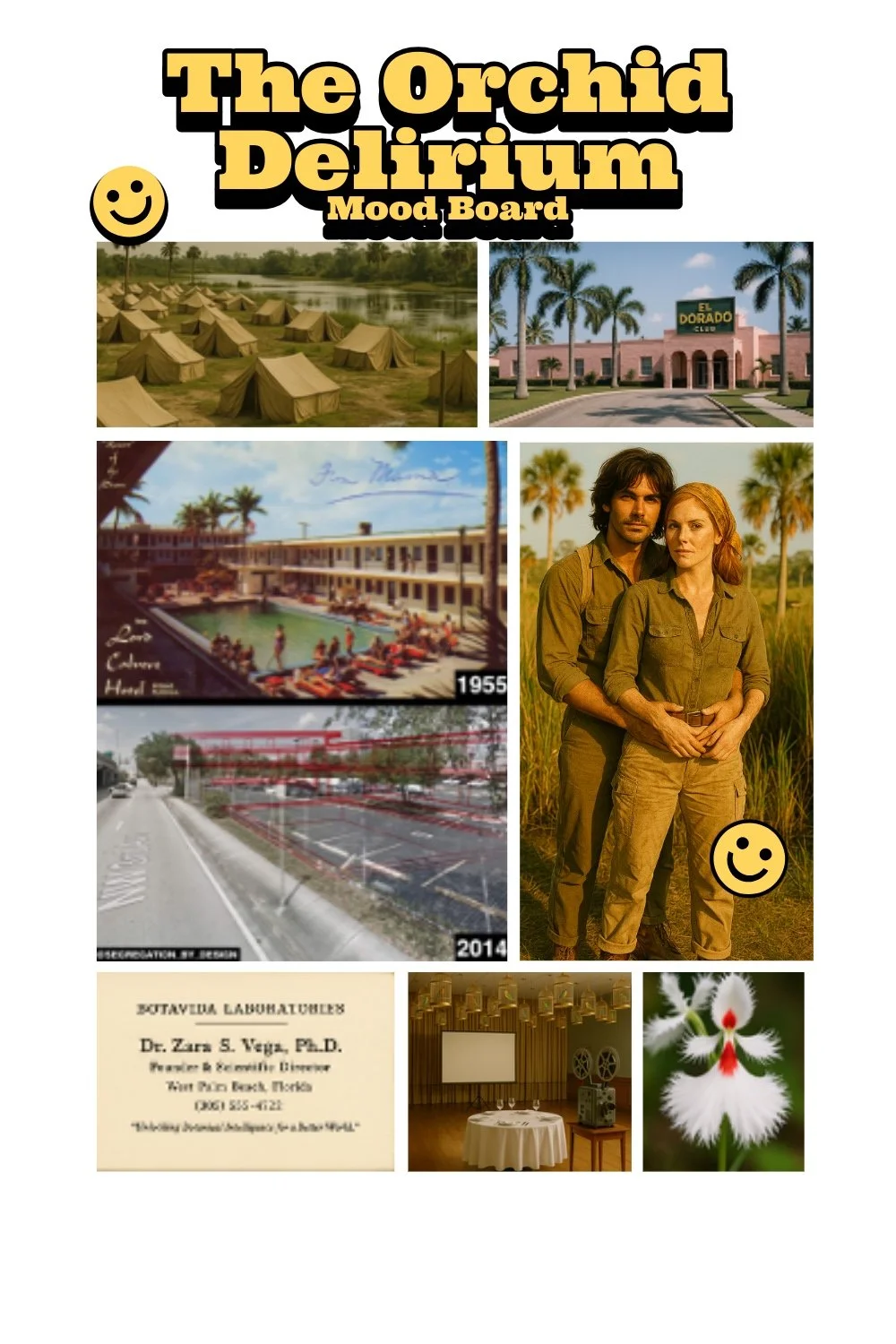
Clockwise from top left:
The Okeela Grove Tent Village — a temporary settlement for families displaced when Black neighborhoods in Miami were demolished to make way for I-95.
The El Dorado Club — a fictional Palm Beach hotel where Hollin and Nora’s absurd, volatile showdown takes place.
Callum and Nora in the swamp — closeness edged with danger, the land pressing in on the body and the heart alike.
The Ballgown Orchid — rare, luminous, unsettling; beauty that invites obsession.
The screening room — birdcages suspended like witnesses, a projector poised to unspool something deliberately forbidden.
Dr. Zara Vega’s business card — clean lines, quiet authority, the promise of science that may not be benign.
Before and after images of a Black Miami community — bulldozed for the I-95 expansion, a visual record of loss rendered mundane by bureaucracy.
